|
|
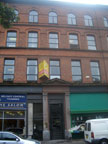
It was during the early part of his career that Padraic Gregory's practice was based at 124 Donegall Street. 'Marsh's Buildings' (now mistakenly designated 'Marshall's Buildings' in a contemporary brass plaque) spans nos. 120-138, a four-storey red brick warehouse building with sandstone detailing, dating from 1894. Patton tells us that the lower part of the site had been occupied by S Boyd and Co's Belfast Foundry through the 19th Century, the upper part, Marsh's Biscuit Factory, which was destroyed by fire in 1905. Belfast street directories list "Gregory and Hall, architects and civil engineers" at unit 10 in the building from 1913 through 1922. This is somewhat confusing, as both Carabine and Larmour state that Gregory initially set up practice with J. Norman Hall in 1906, but by 1910 was working alone. This anomaly could be explained by the directory listing not being updated correctly, or perhaps Hall and Gregory were working separately but retained their joint designation for business purposes. However, Carabine's compilation of information from the 'tendered' and 'approved' sections of The Irish Builder and Engineer, shows that the projects ascribed to Gregory alone between 1913 and 1926 were minor but that after 1926, they jump dramatically. This could suggest that Gregory did, after all, continue to work with Hall until 1922 (although other factors, especially Gregory's activity as a writer and editor, at which he was most active during the teens and early twenties, should also be borne in mind). Either way, the 1923 listing for unit 10 reads just: "Gregory, PB MRIAI, architect and civil engineer. McEntee, J GIEE Consulting Engineer." So we can at least be certain that Gregory was operating independently at this stage. The other businesses listed in the building at that time provide an interesting snapshot of the area in the 1920's: 'Abstainers and General Insurance Co. - Wm. Gibson dist mngr.'; 'Watters, W.A. house and land agent, auctioneer'; 'Hayes & Son, wholesale clothier & warehouseman'; Cosgrave, John, auditor and certified accountant'; 'Carlisle, Thomas E., house and land agent'; 'Commissionaires' Office - Capt. Daly, officer in charge; officer, Sergt. Major A. Cree'; Crossin, H., store room'; Curry, W.J., agent'; 'Vacant'; 'Beatie, John, caretaker'.
|
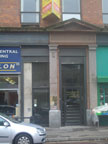 The entrance to 'Marsh's Buildings', now occupied by The Law Centre. |
|
|
|
So we can conjure a picture of Gregory in 1923 as at a crucial point in his life and career. Then 35 years of age, he has already been working as an architect for twenty years, though the schemes he has been involved in solely appear to have been piecemeal. On the other hand, he has published eight books between 1912-20. Interestingly, though, after 1920, Gregory was not to publish again until 1933 - though his plays Bethlehem: A Nativity Play and The Coming of The Magi were to be produced in 1928 and 1931 respectively. 1923 can be imagined, then, as something of a transitional year: a break from the prolific output of poetry throughout the teens, but still a few years before the major ecclesiastical commissions at St Colmcille's and St Mary's, that were to make his name as an architect. It was the first year that he is listed as practicing on his own, but also the final year at 124 Donegall Street, where he had been based for at least ten years. After 1923, Gregory's listing disappears from the street directories until 1933, when he reappears at 3 College Square North as 'Gregory P.B. Architect', the address he was to maintain throughout his most active years as an architect. |
|
|
|
|
|
|
|
|
|
|
|
|
|
|
|
|
|
|
|
|
|
|
|
|
|
|
|
|
|
|
|
|
|
|
|
|
|
|
|
|
|
|
|
|
|
|
|
|
|
|
|
|
|
|
|
|
|
|
|
|
|
|
|